Ruto won the popular vote in 2022. Here is how he could do it again
Three in four Kenyans say the country is on the wrong track, yet William Ruto leads or ties every national poll. We set out the numbers behind his 2022 win, the advantages of the office he holds, the six moves he is making to win again, and what could still stop him.
KGPublished · 9 min read
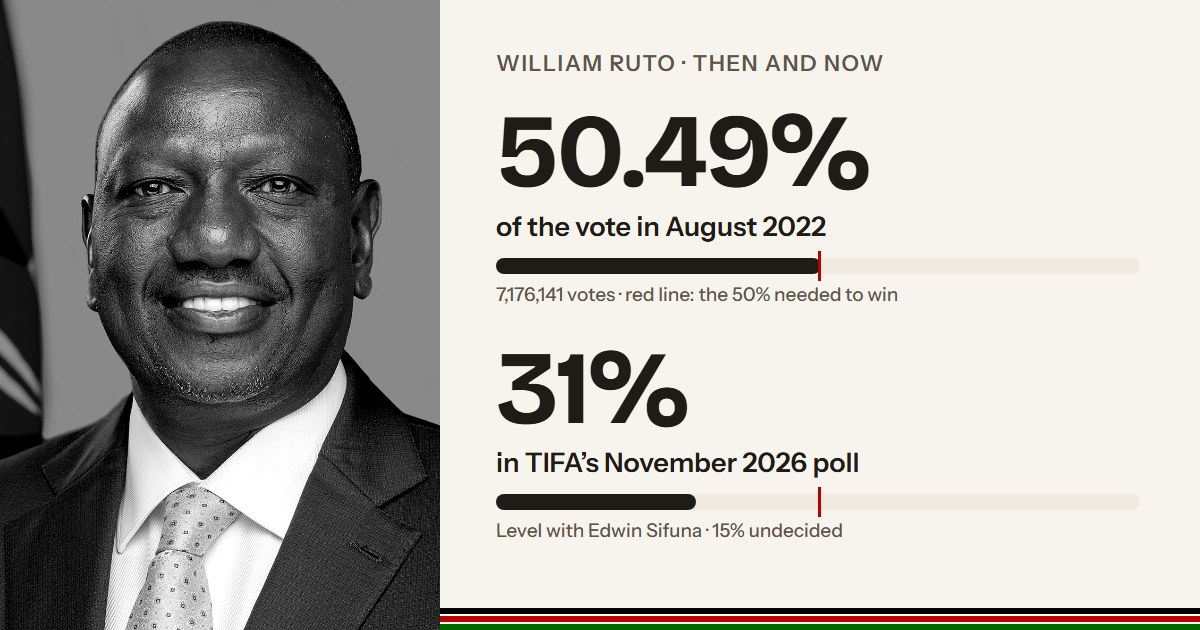
- 233,211Votes between Ruto and Odinga in 2022
- 15%Voters who have not yet chosen, in TIFA's November 2026 poll
- 76%Kenyans who say the country is on the wrong track
With nine months to the election, it is easy to find Kenyans who say William Ruto is finished. It is harder to find the numbers that say so.
He won the popular vote four years ago. He holds an office that no Kenyan President has ever lost at the ballot. And in the newest national poll he is level at the top, not trailing. This article sets out the case that he can win again, the moves he is making, and the things that could still stop him. It is not a prediction, and it is not an endorsement.
What happened in 2022
On 15 August 2022 the IEBC declared Ruto the winner with 7,176,141 votes, or 50.49%. Raila Odinga had 6,942,930, or 48.85%. The gap was 233,211 votes. Ruto also passed the second test, winning at least 25% in 39 of the 47 counties (The Star, Daily Maverick).
Three things about that result matter now:
- He won against the State. President Uhuru Kenyatta backed Odinga. Ruto still took about 77% of the vote in the ten Mt Kenya counties, roughly 2.9 million votes, about four in every ten he received.
- It was close, and it was contested. Four of the seven IEBC commissioners disowned the result. The Supreme Court heard the petition and upheld the win on 5 September 2022.
- Many voters stayed home. Turnout was 64.77% of 22.1 million registered voters (results summary). The people who did not vote outnumbered either candidate's supporters.
So the starting point is a President who has already built a winning majority once, without the advantages he has today.
The office he holds
Since multiparty elections returned in 1992, a sitting Kenyan President has asked for another term four times: Daniel arap Moi in 1992 and 1997, Mwai Kibaki in 2007 and Uhuru Kenyatta in 2017. All four stayed in office. Two of those wins were bitterly disputed: 2007 ended in violence that killed more than 1,000 people, and the first 2017 result was annulled by the Supreme Court before Kenyatta won the repeat poll. Power has changed hands at the ballot only when the seat was open, in 2002, 2013 and 2022.
Kenya is not unusual. A study by the political scientist Nic Cheeseman of presidential elections in sub-Saharan Africa between 1990 and 2009 found that sitting presidents won about 88% of the contests they entered, a figure cited in the Nation in a piece asking whether "the system" can allow Ruto to lose.
What does the office give him? A President decides where projects are launched and when. He travels at public expense and is covered wherever he goes. He appoints, and so he can reward. His coalition controls the agenda in Parliament. None of this is a secret plot. It is what incumbency means, and every President before him has used it.
Where he stands today
- TIFA, released 12 November 2026: Ruto 31%, Edwin Sifuna 31%, Kalonzo Musyoka 9%, Fred Matiang'i 5%, Rigathi Gachagua 4%, undecided 15% (Eastleigh Voice, Capital FM).
- His own line is rising. In TIFA's surveys his share has gone from 16% in September 2025 to 19% in November 2025, 24% in June 2026 and 31% now (Mwakilishi).
- He has led every other national poll in our tracker, with shares between 24% and 45% depending on the pollster and the method. See the poll tracker.
Two readings of those numbers are both true. He is nowhere near the 50% plus one vote he needs. And nobody is ahead of him.
Six moves he is making
1. Replace the votes he has lost with ODM's
On 10 August 2026, exactly a year before the election, Ruto and ODM leader Oburu Oginga announced in Naivasha that their parties would write a joint manifesto and contest 2027 together (Pulse). ODM's deputy leader Junet Mohamed has said the party is not looking for a presidential candidate and that everything below the presidency is open to negotiation (People Daily).
This is the centre of the plan. Odinga, who died on 15 October 2025, won 6.9 million votes in 2022. Ruto does not need all of them. He needs enough to cover what he loses in Mt Kenya. TIFA's new poll suggests it is partly working: Ruto has 62% in Nyanza, Odinga's home region, and leads Sifuna 42% to 33% among ODM supporters.
2. Lose Mt Kenya by less
Since the impeachment of Rigathi Gachagua in October 2024, the region that gave Ruto his biggest block of votes has turned against him. In the Ol Kalou by-election in July 2026, Gachagua's party, DCP, beat UDA with about 86% of the vote in provisional tallies (The Star). Gachagua says Ruto will get 2% in the region.
Ruto does not have to win the mountain. He has to avoid being wiped out. Here is our own rough sum: if his share in the ten Mt Kenya counties fell from 77% to 25% on the 2022 turnout, he would lose about 2 million votes. That is the hole the ODM pact must fill. Every point he holds in Mt Kenya makes it smaller. This is why Deputy President Kithure Kindiki leads the "empowerment" tours there, and why allies talk up Mt Kenya East (Embu, Meru and Tharaka Nithi) as separate ground. UDA won the Mbeere North by-election in Embu. The analyst Peter Kagwanja told The Star that Ruto's target in the region is about 20%.
3. Point at things people can see
The Star reported in March that Ruto is touring counties to launch projects, lead fundraisers and hand out support to youth, women, boda boda riders and traders, and that he has proposed a Sh5 trillion infrastructure fund (The Star). Each programme comes with a number he can quote:
- Health cover: 32.3 million people registered with the Social Health Authority by August 2026 (The Star).
- Housing: about 10,000 affordable units completed and 8,000 occupied by September 2026 (The Star).
- Youth grants: Sh5.34bn paid to 124,522 young people under the NYOTA programme in the year to June 2026 (Business Daily).
- Hustler Fund: Sh87bn lent since its launch, according to Treasury figures (TechTrends KE).
Each number also has a weaker side. Only about 5 million SHA members are paying in (Capital FM). The housing programme has delivered less than half its target (People Daily). The Hustler Fund got no new money in this year's budget. And critics, among them the lawyer PLO Lumumba, call the empowerment drives campaigning with public money (K24). Kindiki's answer is that the critics promise during campaigns and vanish afterwards.
4. Change the question
Asked "are you happy with the last five years?", most Kenyans say no. So Ruto is asking a different question. At Chebara in Elgeyo Marakwet in October he told voters to "vote for a plan", said the opposition has no agenda beyond "tribal arithmetic", and said he would beat it whether it unites or not (The Star).
The aim is to make 2027 a choice between two options and not a verdict on one man. An unpopular incumbent can win a choice. He rarely wins a verdict.
5. Let the opposition argue
Added together, the opposition's names beat Ruto in most polls. But the opposition does not yet have a candidate. Kalonzo wants the ticket settled by negotiation; Gachagua and Matiang'i want it settled by polling. When Gachagua floated a pact of himself, Kalonzo and Sifuna, Matiang'i called it majoritarian arrogance. The three met on 8 November to calm things down, then went to two different rallies the same day (Mwakilishi).
Sifuna, the opposition's strongest name, was removed as ODM secretary general in February and is still building his own party, Linda Mwananchi. TIFA notes that the 19% held by other opposition figures would take him to 50% if it all moved to him, and adds that nobody should assume it will.
A caution for Ruto's side: a split opposition does not hand him the presidency. He still needs more than half the votes cast, or the race goes to a run-off, and a run-off is where a divided opposition is most likely to unite. What the quarrels give him is time, and a year of headlines about rivals fighting each other.
6. Win the register before the vote
Elections are decided partly by who is on the roll. The IEBC wants 28.5 million registered voters by 2027, about 6.3 million more than in 2022 (The Star). At Chebara, Ruto closed by telling residents to get IDs and voter cards. Whoever registers more of their own supporters, and then gets them to turn out, starts ahead. In 2022 turnout in Ruto's Rift Valley base was above the national figure, while turnout in Mt Kenya fell.
Does he control "the system"?
Many Kenyans believe the President's real advantage is the machinery that runs the election. Here is what can be shown and what cannot.
What can be shown. The IEBC chair, Erastus Ethekon, and his commissioners were appointed by Ruto in 2025 after a selection process and a vote in Parliament, where his side has the numbers. The commission has had no permanent chief executive since February. Public trust is low: 30% of Kenyans told TIFA they trust the IEBC (People Daily).
What is claimed. Gachagua has alleged that the commission's leaders are steering an election technology tender. The IEBC says that is false. Ethekon has said the commission will guard its independence "at all cost". These are accusations by a rival, not established facts.
What limits any President. In September 2026 the High Court confirmed that results declared at the constituency are final and can be changed only by a court. In October the National Assembly kept the legal requirement to livestream results. The Supreme Court annulled a sitting President's win in 2017. And in 2022 the candidate backed by the State lost. Ruto knows that better than anyone, because he was the one who beat it.
The fair summary: the office tilts the field before polling day, through money, attention and appointments. There is no public evidence that it decides the count.
What could still stop him
- The mood. 76% of Kenyans told TIFA the country is heading in the wrong direction, and 90% in Mt Kenya (Nairobi News).
- Prices. Inflation was 7.3% in October 2026, the highest since July 2023. Transport costs were up 17.1% and food 10.2% in a year (Citizen). Petrol in Nairobi is Sh226.96 a litre after a Sh12.93 rise blamed on the conflict in the Middle East (Pulse). A year ago inflation was 4.6%. If he planned to campaign on cheaper living, that plan is in trouble.
- A single opponent. TIFA says no other candidate has made such a strong first showing in pre-election surveys going back to at least 1997. Sifuna has drawn level with a sitting President nine months out.
- His own party. People Daily reports that former allies are leaving UDA, taking with them some of the grassroots networks that won 2022 (People Daily). And the ODM pact has not settled who gets what.
- The undecided. 15% have not chosen. They are more than enough to settle a tied race.
The bottom line
Ruto is unpopular, and he is competitive. Both are true at once. He has won the popular vote before, he holds the office that has never been lost at the ballot, he has a new coalition where his old one broke, and his opponents have not agreed on who should face him.
Whether that is enough depends on three things you can track between now and August: the price of food and fuel, whether the opposition names one candidate, and how much of Mt Kenya he keeps. We will follow all three on the 2027 race page and in the polls.
Sources
This article links to 26 sources from 14 publications. Every figure links to its source where it appears.
- The Star 7
- People Daily 4
- Capital FM 2
- Mwakilishi 2
- Pulse 2
- Daily Maverick 1
- Wikipedia 1
- Nation 1
- Eastleigh Voice 1
- Business Daily 1
- TechTrends KE 1
- K24 1
- Nairobi News 1
- Citizen 1
Share this article
Spotted an error in this article? Send it in.
More articles
All articles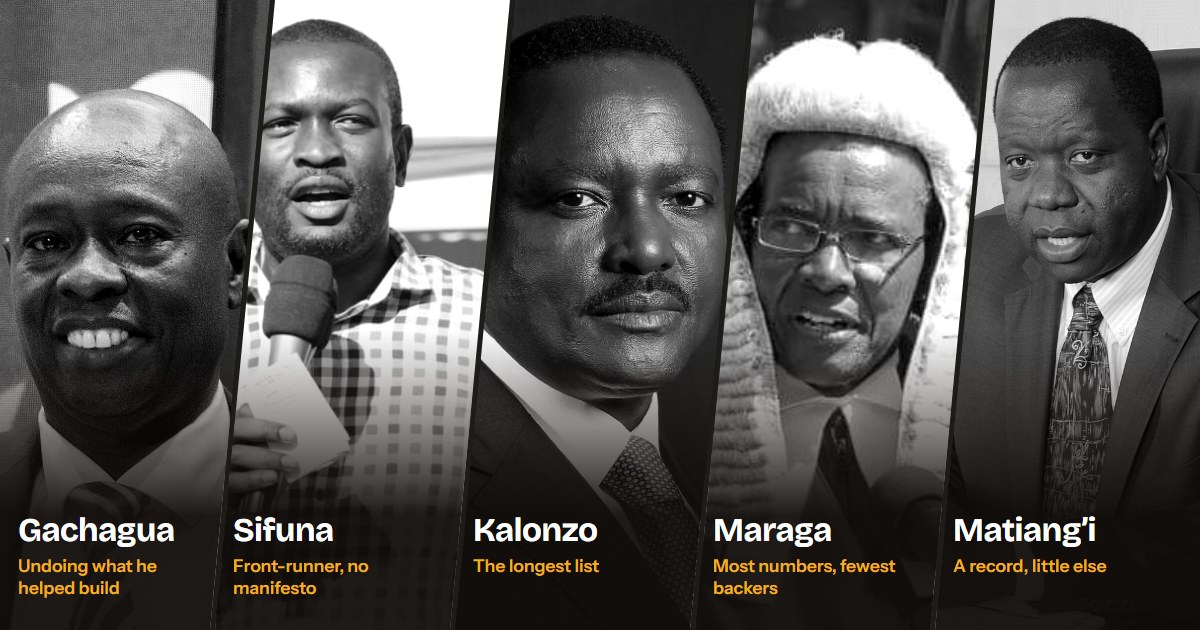
“Ruto must go.” Then what? What his five main challengers say they would do
Gachagua, Sifuna, Kalonzo, Maraga and Matiang'i all want William Ruto out. We checked what each has promised to do in his place. They have plans, but most of the promises are things to undo, several cannot be done the way they are described, and together they cost far more than the budget has.
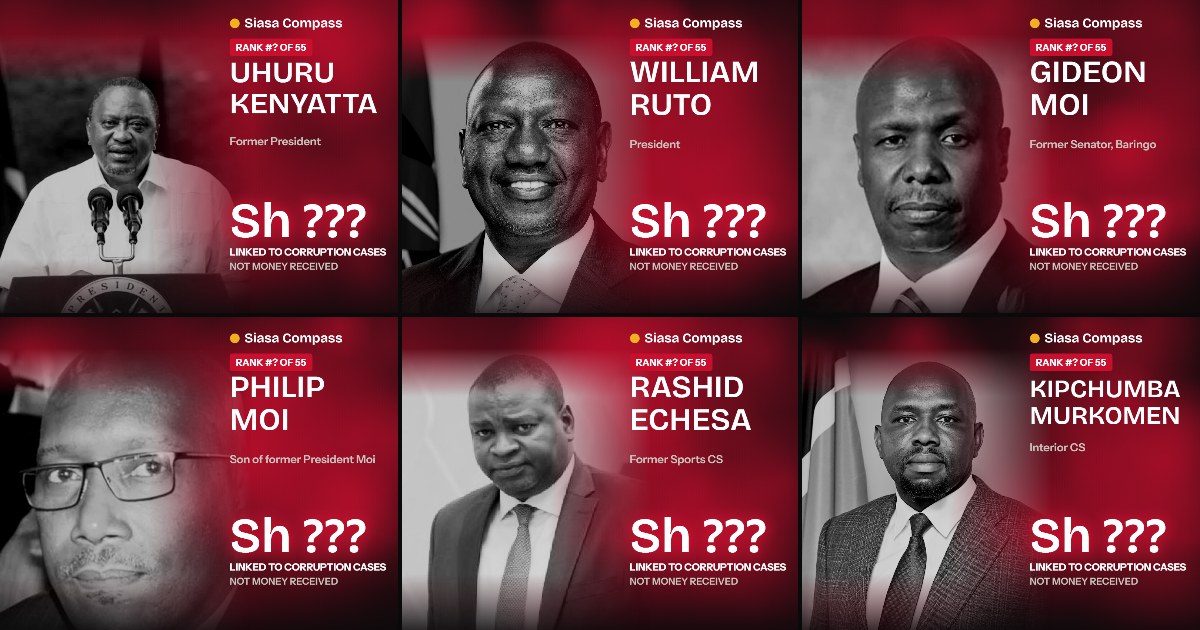
Which leaders are linked to the most corruption money?
We ranked 52 Kenyan leaders by the public money lost or questioned in their cases and the offices they led. The top figure is Sh174bn, ten leaders pass Sh10bn, and the only two convicted in court are ranked 48th and 50th. See who is on the list.
How Kenya's next President will be chosen
Winning the most votes is not enough. A candidate needs more than half of all votes and a quarter of the vote in at least 24 counties, or the race goes to a run-off.