“Ruto must go.” Then what? What his five main challengers say they would do
Gachagua, Sifuna, Kalonzo, Maraga and Matiang'i all want William Ruto out. We checked what each has promised to do in his place. They have plans, but most of the promises are things to undo, several cannot be done the way they are described, and together they cost far more than the budget has.
KGPublished · 11 min read
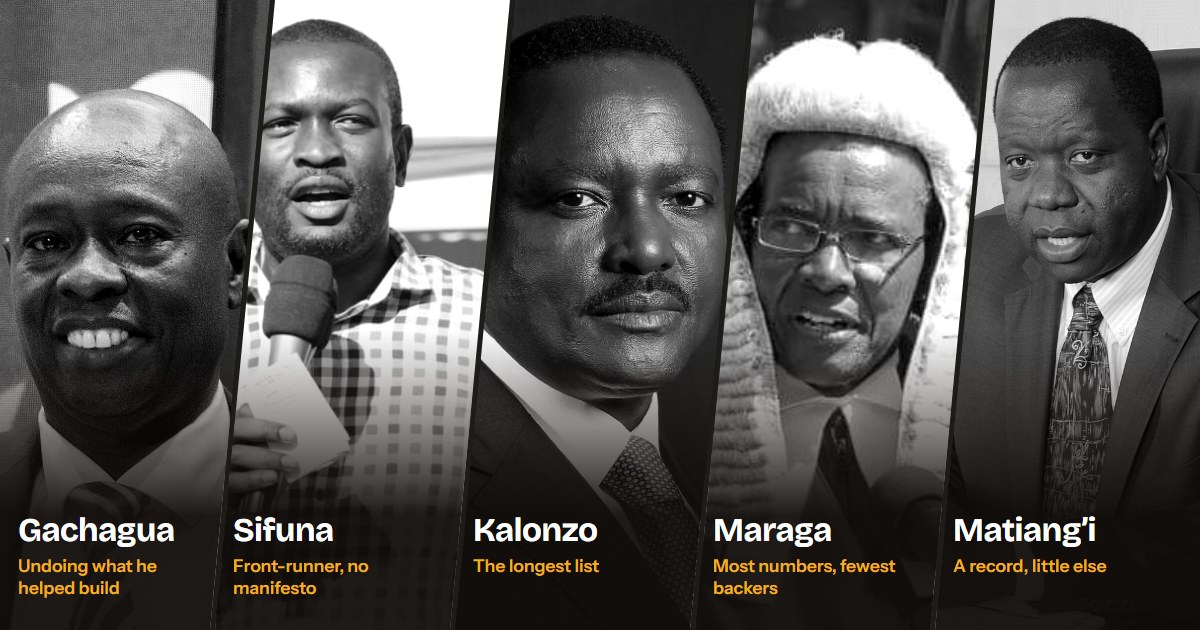
Ask any of William Ruto's main challengers what is wrong with Kenya and you will get a long, confident answer. Ask what they would do about it and the answers get shorter.
That is the common complaint about the opposition: that it is running against a man and not for anything. Ruto makes it himself. In October he told a crowd in Elgeyo Marakwet that his rivals have no plan beyond "tribal arithmetic" (The Star). His spokesman, Charles Owino, put it as a question in August: what would they do better? (The Star)
We tested the complaint against the record of five of them: Rigathi Gachagua, Edwin Sifuna, Kalonzo Musyoka, David Maraga and Fred Matiang'i. The short version: it is half right. They are not silent. Every one of them has made promises. But most of those promises are about removing what Ruto built, their one joint plan carries no figures, and what voters hear most is still the slogan.
What voters say they want
When Infotrak asked Kenyans in December 2025 which issues decide their vote, they said: the cost of living (46%), corruption (27%), healthcare (27%), education (26%) and jobs for young people (25%). Our issues page tracks what every candidate has done or promised on each one. This article draws on it.
The five, one by one
Here is what each has promised. The table after the five tests every promise against this year's budget figures and what happened the last time someone tried.
Kalonzo Musyoka: the longest list
Kalonzo launched his "Komboa Kenya" platform in June 2026 (Nation). He has promised to:
- audit all government funds, loans and contracts within 60 days of taking office (Citizen);
- scrap the Housing Levy by his first executive order (The Star);
- scrap the Social Health Authority and go back to NHIF;
- raise the counties' share of national revenue from 15% to 35%;
- guarantee every child an education from primary school to university, a pledge he made at Kitengela on 8 November (Mt Kenya Times).
It is the most complete list of the five. But the firmest items on it begin with "scrap", "audit" or "go back", and the newest ones, like free education to university, come with no cost and no source of money.
David Maraga: the most numbers, the fewest supporters
The former Chief Justice has put the most figures on paper. In June 2026 his party petitioned Parliament for a Sh300bn youth jobs programme: Sh7,000 a month for a year to two million unemployed young people, start-up grants for 400,000 more, and money for technical training (Eastleigh Voice). He has proposed capping debt repayments at about Sh600bn a year and freezing non-essential borrowing (Capital FM).
On youth jobs, the issue a quarter of voters rank first, he is the only one of the five with a plan that has a price on it.
He is also at about 1% to 2% in the polls.
Edwin Sifuna: the front-runner without a manifesto
Sifuna is level with the President at 31% in TIFA's November poll. His promises so far:
- cut Sh500bn from government spending, and spend his first 100 days cutting waste, starting at State House (Eastleigh Voice);
- remove taxes on fuel and electricity;
- return Mumias Sugar to public ownership.
None of these comes with a plan for how. His party, Linda Mwananchi, has not yet published a manifesto. Asked on Citizen TV in July what comes after "Ruto must go", he said the government Kenyans want is already written in the Constitution, and named no policy (Citizen). On corruption, education and jobs, our issues page has nothing on record for him yet. In July 2025 he said plainly that removing Ruto was the opposition's top priority (The Star).
Rigathi Gachagua: promising to undo what he helped build
Gachagua says he would scrap the Housing Levy on his first day, hand the finished houses to counties and refund contributors (Kenyans.co.ke). He leads the push to scrap SHA. He has set out a 100-day plan covering corruption, the cost of living and lower taxes (Nation).
Two things weaken it. First, as Deputy President he championed the Finance Act 2023, which created the Housing Levy and doubled VAT on fuel. Under this site's evidence rules, a promise that a leader's own record contradicts is not counted. Second, he has said more than once that the plan starts after Ruto leaves: the first step in restoring the country, he says, is to remove him (People Daily).
Fred Matiang'i: a record, and little else so far
Matiang'i's pitch is his past: the Education Cabinet Secretary who cleaned up national exams, the Interior CS who ran the police. He has dared rivals to "bring your track record" (Citizen) and promised to crack down on political violence. He has said rising school dropout rates would be a priority. His party, Jubilee, says its agenda is still being written. On the cost of living, healthcare and jobs, our issues page has nothing on record for him.
Can it be done? Every promise, tested
Sums marked "our sum" are our own arithmetic from the published figures.
| Who | Promise | Can it be done? | Why |
|---|---|---|---|
| Kalonzo | Audit all government funds, loans and contracts in 60 days | Not by a President's order | Ruto tried in July 2024. The High Court suspended his debt-audit task force in three days and later struck it down: auditing the debt is the Auditor-General's job (Capital FM). |
| Kalonzo, Gachagua | Scrap the Housing Levy on day one | No | The levy is in an Act of Parliament, upheld by the Court of Appeal in September 2026 (Rio Times). An executive order cannot cancel a law. It takes a majority in Parliament, and a way to replace the Sh79bn it raised last year. |
| Kalonzo, Gachagua | Scrap SHA and go back to NHIF | Possible, with a new law | NHIF was abolished by an Act of Parliament too. SHA has 32.3 million people registered, nearly twice NHIF's peak, and all would have to be moved again. |
| Kalonzo | Raise the counties' share from 15% to 35% | Not without about Sh290bn | Counties already get more than 15%: Sh428bn this year, about 21% of the last audited revenue (The Standard). 35% would be about Sh717bn (our sum). Governors asked for Sh535bn this year and did not get it. |
| Kalonzo | Free education from primary school to university | The money is not there | Even today's system is short. The loans board needs Sh114bn for students this year and has Sh57bn (The Star). |
| Maraga | Sh300bn programme for three million jobless young people | Only by cutting or borrowing as much | It is more than the whole defence budget (Sh252bn) and about 56 times what the government's youth grants paid out last year. The budget is already about Sh1.15 trillion short (Capital FM). |
| Maraga | Cap debt payments at about Sh600bn a year | Not without missing payments | Fixed obligations, mostly debt and pensions, are about Sh1.5 trillion this year. Paying less than half means lenders must agree new terms: a restructuring. |
| Sifuna | Cut Sh500bn from spending, starting at State House | About three times the most ever cut | In 2024, with protesters in the streets, the target was Sh177bn and the Treasury fell short of it (Citizen). Scrapping the offices of the First Lady and the Deputy President's spouse saved Sh1.3bn. |
| Sifuna | Remove taxes on fuel and electricity | Only if the Sh500bn is found first | Fuel brings in about Sh100bn a year in VAT alone, before the Sh25 road levy and Sh21.95 excise on every litre. Halving the VAT for three months cost about Sh13bn (Nation). |
| Sifuna | Return Mumias Sugar to public ownership | It is not the government's to take | Mumias has been in receivership since 2018. A private operator runs the mill under a lease, and lenders hold its ethanol and power plants. Creditors would have to be paid off first. |
| Gachagua | Refund Housing Levy contributors from rent | The money has been spent | Sh206bn had been paid in by June 2026 (Precursor). About 10,000 homes are finished. At Sh10,000 a month each, repaying it would take about 170 years (our sum). |
| Gachagua | Lower prices and lower taxes in 100 days | He has promised it before | The 2022 Ruto-Gachagua ticket made the same pledge. When the 100 days passed, Ruto asked for a year (Citizen). |
| Gachagua | Revoke titles to 150,000 acres of grabbed land | Twenty years of failure say otherwise | The Ndung'u report listed grabbed public land in 2004 and was never fully acted on. Only the High Court can cancel a title, one case at a time (The Standard). |
| Matiang'i | Crack down on political violence | Yes | It is within a President's power, and he has run the police before. He has promised little else that can be tested. |
What the lists have in common
Put the five side by side and four patterns show.
1. Most of the promises are about undoing. Scrap the Housing Levy. Scrap SHA. Go back to NHIF. Reverse the sale of Kenya Pipeline. Audit the loans. These tell a voter what will stop. They say less about what starts. NHIF, the system three of them want back, was itself dogged by fraud and unpaid hospital bills.
2. The one joint plan has no numbers in it. In June, Kalonzo, Gachagua and Matiang'i published a "People's Budget": more money for schools and hospitals, a youth jobs programme, cheaper fuel, no Housing Levy. It gave no amounts and no source of funds (Radio 47). Sifuna and Maraga were not part of it. Ruto and ODM, meanwhile, set up a joint manifesto committee in August. What the opposition shares today is rallies, a slogan ("Wantam", one term) and an argument over who gets the ticket, which we covered here.
3. The loudest promise is not about what voters rank first. Scrapping the Housing Levy is the day-one pledge of both Kalonzo and Gachagua. Only 3% of voters name affordable housing as their top issue. Jobs for young people, named by 25%, has one costed plan among the five.
4. The promises cost more than the budget has. Take only the items with a price: Sh300bn for youth jobs, about Sh290bn more for counties, the Sh79bn the Housing Levy raises, Sh100bn or more in fuel taxes, a Sh57bn gap in student loans. That is over Sh800bn a year of new spending and lost revenue, in a budget that is already Sh1.15 trillion short. Against it stand one proposed saving, Sifuna's Sh500bn, which is about three times the 2024 cuts, and one hope that several of them share: that money recovered from corruption will cover the rest. Nobody has put a figure on it. Different leaders made these promises, so no one of them owes the whole bill. But a united opposition would inherit all of them.
Some of this is the gap between a rally and a law. A President cannot scrap a levy, cancel a title deed or order a debt audit with a signature. Ruto has learned that in court more than once.
It is not only Ruto's side saying so. The analyst Herman Manyora has said "Ruto must go" is not enough (People Daily). Jimi Wanjigi, no friend of the President, has argued that the opposition needs ideas and not only a target (Nation).
But do voters reward detail?
Here the evidence turns against the easy conclusion. If detailed plans won votes, Maraga would be leading and Sifuna trailing. It is the other way round. Kalonzo, with the longest list, has fallen from 25% to 9% in TIFA's polls in a year.
So far, voters are not choosing the opposition figure with the best plan. They are choosing the one who looks most likely to beat Ruto. With 76% saying the country is heading in the wrong direction, "not him" is a strong message on its own.
The lesson from America, read carefully
Kenyan opposition leaders have been pointing to the United States, where the Democrats swept the midterm elections on 3 November, two years into Donald Trump's second term (CNBC). At the Kitengela rally five days later, one MP asked the crowd whether they had seen what Americans did to Trump. Another said jobs for young people require Ruto to go (Dawan Africa).
The fuller record is less comforting. The Democrats have run mainly as the party that is not Trump for ten years. It worked when voters were judging Trump in office: 2018, 2020 and this month. It failed in 2016 and 2024, when voters were choosing between two people and wanted to know what each would do for them. The party's own review of the 2024 defeat told it to talk less about its opponent and more about the cost of living (Washington Times).
Being against the man in power can win a verdict. It does not win a choice. And turning 2027 from a verdict into a choice is exactly what Ruto is trying to do.
The bottom line
The claim that the opposition has said nothing is wrong. Kalonzo has a platform, Maraga has costed a jobs programme, Sifuna and Gachagua have 100-day promises.
The claim that it has not yet shown how life would be better is harder to dismiss. Its promises mostly cancel things. Several cannot be delivered by a President alone, and the ones with a price add up to more than Sh800bn a year that nobody has found. Its one shared plan has no figures, and two of the five are outside it. And on jobs, education and prices, the things Kenyans say they vote on, the detail is thin where the support is highest.
Ruto will ask voters to compare plans. Sooner or later the opposition will need one to hand them. You can compare every candidate, promise by promise, on the issues page.
Pictures, via Wikimedia Commons: Gachagua by Nicolas Landemard / European Union (CC BY 4.0); Sifuna by LuffyDe (CC0); Kalonzo by Raidarmax (CC BY-SA 3.0); Maraga by Carltdpp (CC BY-SA 4.0); Matiang'i by ICT Authority (CC BY 2.0). Cropped and shown in black and white; the collage may be reused under CC BY-SA 4.0.
Sources
This article links to 31 sources from 16 publications. Every figure links to its source where it appears.
- The Star 5
- Citizen 5
- Nation 4
- Eastleigh Voice 2
- capitalfm.co.ke 2
- People Daily 2
- The Standard 2
- mountkenyatimes.co.ke 1
- Kenyans.co.ke 1
- Capital FM 1
- riotimesonline.com 1
- precursor.africa 1
- radio47.fm 1
- cnbc.com 1
- dawan.africa 1
- washingtontimes.com 1
Share this article
Spotted an error in this article? Send it in.
More articles
All articles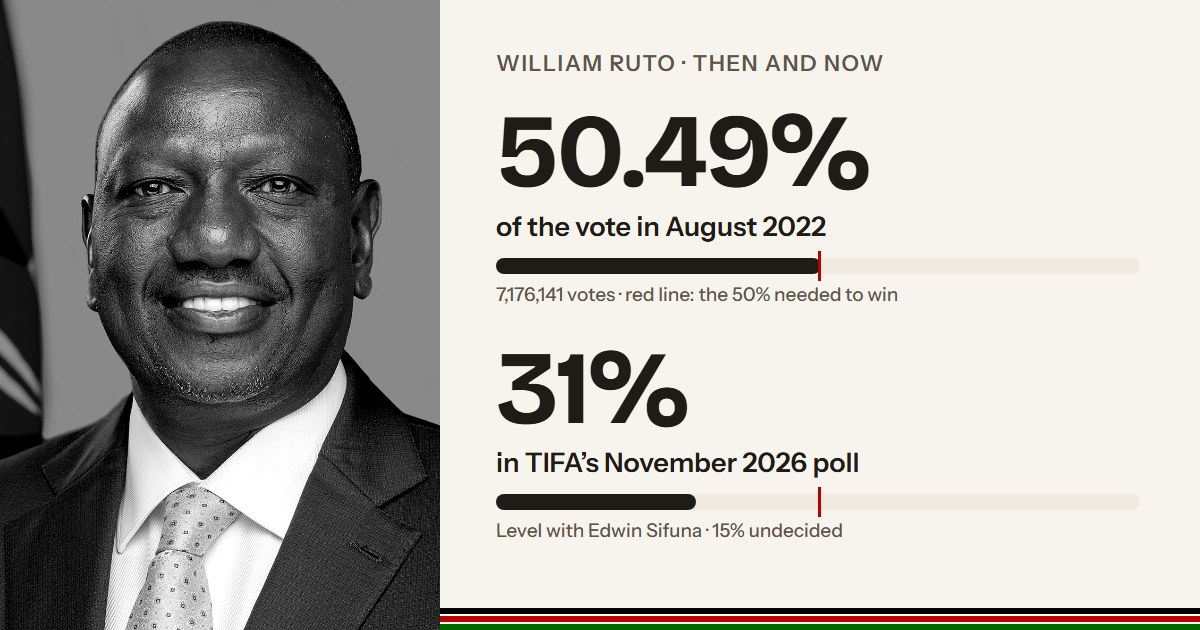
Ruto won the popular vote in 2022. Here is how he could do it again
Three in four Kenyans say the country is on the wrong track, yet William Ruto leads or ties every national poll. We set out the numbers behind his 2022 win, the advantages of the office he holds, the six moves he is making to win again, and what could still stop him.
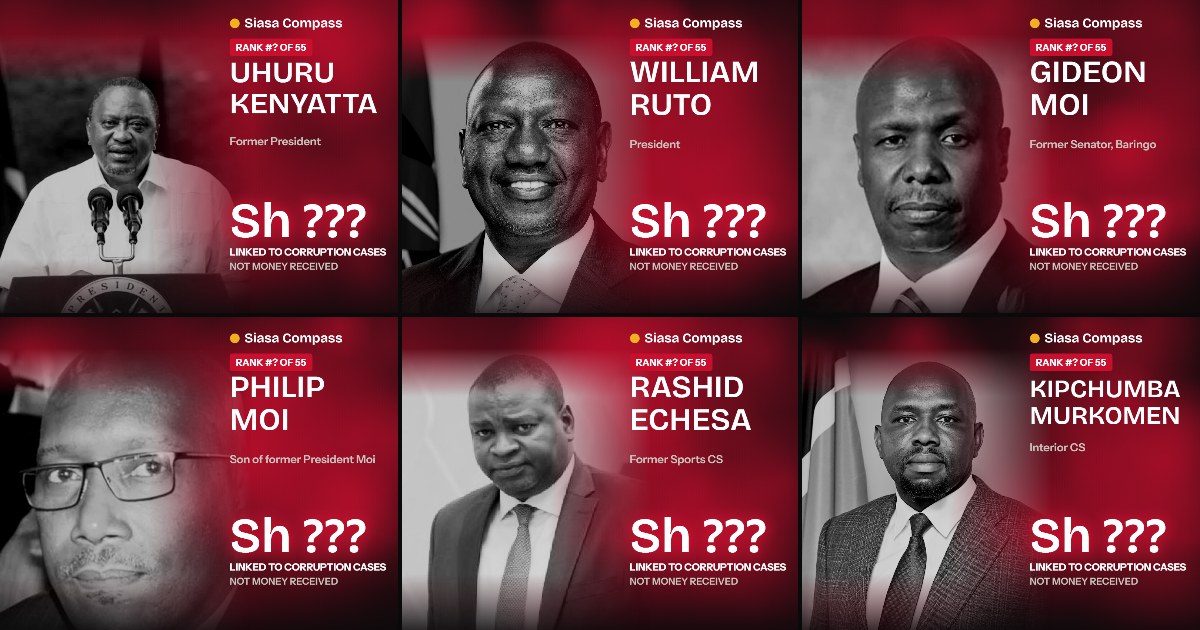
Which leaders are linked to the most corruption money?
We ranked 52 Kenyan leaders by the public money lost or questioned in their cases and the offices they led. The top figure is Sh174bn, ten leaders pass Sh10bn, and the only two convicted in court are ranked 48th and 50th. See who is on the list.
How Kenya's next President will be chosen
Winning the most votes is not enough. A candidate needs more than half of all votes and a quarter of the vote in at least 24 counties, or the race goes to a run-off.